





Almost everyone I meet through this business already knows they should be more organized. They know they should have a system for their notary appointments, a plan for their aging parents’ paperwork, a folder for their family’s important documents, and a backup plan for their small business. Knowing it isn’t the problem. Not knowing where to start is.
The 2026 Trust & Will Estate Planning Report found that 56% of U.S. adults had none of the five core documents included in its survey, such as a will, trust, medical directive, financial power of attorney, or HIPAA authorization (Source: Trust & Will, 2026). Awareness is not always the main obstacle. For many people, the problem is uncertainty about where to begin, and the blank page makes that first step feel even harder.
This isn’t a post about a product launch. It’s about a pattern I kept noticing across four very different groups of people — notaries, caregivers, families, and small-business owners — and what I decided to do about it.
Where I Kept Seeing the Same Problem
Across years of mobile notary work and thousands of appointments, I began noticing recurring challenges: documents scattered across different places, relatives unsure what information existed, and business owners realizing their records weren’t as organized as they thought.
It wasn’t that people didn’t care about being prepared. It’s that preparation felt like a project with no clear starting point — a blank Google Doc, or a vague sense that “someday” they’d get organized. I started sketching simple templates for my own notary business first, just to solve my own version of that problem. Once I saw how much lighter that made things feel, it was obvious the same approach could help the people I was serving, too.
More than once, I watched a family member searching through a plastic bag or a mismatched folder of paperwork during what should have been a simple signing, because there was no single place where the important information lived. The signing itself might take ten minutes. Finding the right documents could take forty. That kind of moment happened often enough that it stopped feeling like a one-off and started feeling like a pattern worth solving.
Who Each Collection Is Actually For
The notary tools — the Notary Business Planner and Appointment Calendar, the Notary Client Intake & Appointment Prep Kit, the Notary Business Operations Binder — are for notaries who are tired of rebuilding the same tracking sheet from scratch, or who are starting and don’t yet know what a solid system even looks like. They’re the tools I wish existed when I was setting up my own systems in year one, instead of piecing them together from trial and error.
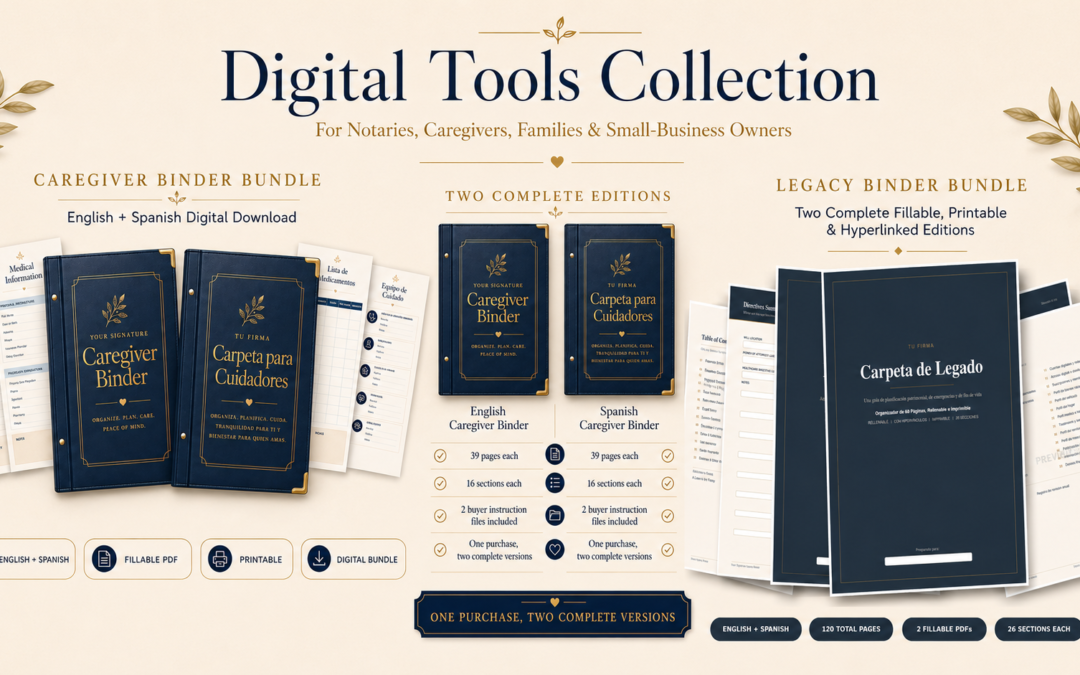
The Caregiver Binder is for anyone who has found themselves suddenly responsible for a parent’s or loved one’s medical, financial, and daily-care information, and who needs it organized somewhere other than scattered folders and sticky notes. It’s available in English, Spanish, and as a bilingual bundle, because that gap doesn’t only affect English-speaking families.
Your Signature Legacy Binder is for families who want to organize existing estate-planning information, emergency contacts, document locations, account details, and end-of-life preferences before a crisis forces the conversation. It organizes what you already have; it doesn’t create a will, trust, power of attorney, or other legal document. And the Small Business Continuity Binder is for small-business owners who’ve never mapped out what would actually happen to their business if they suddenly couldn’t run it for a while.
Different audiences, same underlying need: a starting point that isn’t a blank page.
None of these were designed from a distance. Each one came out of a specific, repeated moment in my own work — the notary tools from my own early scramble to track appointments and invoices, the Caregiver Binder from watching families search through plastic bags for the right document, Your Signature Legacy Binder from conversations with clients who wished they’d organized things sooner, and the Small Business Continuity Binder from my own realization that I’d never actually written down what should happen to my business if I couldn’t run it for a while.
Why Printable and Fillable, Specifically
I didn’t want to build software, and I didn’t want to build something that required a subscription or a login to maintain. Printable and fillable PDF organizers work because they meet people where they already are. They can be completed digitally using a compatible PDF application on a computer or tablet, and they can also be printed and kept in a physical binder. Some fields may work on mobile devices, though the experience depends on the device and the PDF app — no new software to learn during an already stressful moment.
The format also does something less obvious: it breaks an overwhelming task into sections. Nobody has to sit down and “organize their entire life” in one sitting. They fill in one section — medical contacts, or account information, or a single client intake form — and the rest waits until they’re ready for it.
That matters more than it may seem. Large organizational tasks can feel difficult to begin, especially when they compete with more urgent responsibilities. Breaking the process into smaller sections medical contacts, account information, or one client intake form at a time — makes the first step feel more manageable.
I built them with clear labels and plain-language prompts, without assuming that users already know which information to gather or where important records are stored. Just clear sections that add up to something usable once they’re filled in.
How This Connects to Your Signature, My Seal!™
A signature and a seal represent an important moment in a process — one that should be approached with preparation, care, and attention to the notarial requirements. These digital tools extend that same commitment into the preparation and organization that happen before and after an appointment.
It is also the reason I am building Your Signature, My Seal Academy — not only to teach notarial procedures, but to give aspiring notaries a clearer starting point for building their systems and serving clients responsibly. Whether that’s a new notary building their first business system, or a family organizing a loved one’s care information, the underlying service is the same: taking something that felt overwhelming and making it feel possible to start today.
I don’t expect anyone to need all of these at once. Most people find their way to one: a notary looking for a business system, a family facing a caregiving season, someone finally sitting down to write things out for their own family. Wherever you’re starting, the point is the same: you shouldn’t have to build the template before you can even begin the work.
Explore the Collection
These products don’t replace an attorney, financial advisor, medical professional, or important family conversations. They’re organizational tools designed to help you gather information and begin those conversations from a more prepared place.
Whether you’re organizing your notary business, supporting a loved one, preparing your family’s important information, or creating a continuity plan for your small business, you don’t have to begin with a blank page.
Explore YourSignatureTools on Etsy
Disclaimer: These digital products are organizational tools and do not constitute legal, financial, medical, tax, or business-continuity advice. They do not create wills, trusts, powers of attorney, healthcare directives, or other legal documents. Consult appropriately licensed professionals for advice about your individual circumstances.
Valerie Williams | Bilingual Notary | Your Signature, My Seal!™ — Founder of Williams Mobile Signings