





Back-to-school season usually means buying supplies, completing registration forms, arranging transportation, and preparing for a new routine.
However, for families, students, and educators preparing for an international move, study-abroad program, or overseas educational opportunity, the back-to-school checklist can look very different.
In addition to backpacks and enrollment forms, you may need to prepare school transcripts, diplomas, birth certificates, parental documents, or other official records for international use.
That is where apostille services may become part of your back-to-school preparation.
For families, students, and educators in Metro Atlanta preparing for an international school year, July is a smart time to begin asking an important question:
Are my documents ready for international use?
Waiting until the last minute can create unnecessary stress, especially when you are unsure which documents are required, how they must be prepared, or which authentication process applies.
Starting early gives you time to understand the requirements before your school enrollment, study-abroad, relocation, or employment deadline gets too close.
What Is an Apostille?
An apostille is a form of authentication used for certain documents that will be presented in another country.
Depending on the document and its destination, an apostille may be required before a school, university, employer, ministry, or government agency abroad will accept it.
One of the most common areas of confusion is the difference between notarization and an apostille.
They are not the same thing.
A notary may be involved in preparing certain documents before the apostille process begins. However, the apostille itself is issued by the appropriate government authority.
The exact process can depend on several factors, including:
- The type of document
- Where the document was issued
- How the document was prepared
- The country where the document will be used
This is why apostille preparation should begin with the document itself, not simply with a request for “an apostille.”
Understanding what you have and where it is going is an important first step.
Not Every Country Uses the Apostille Process
Before beginning, it is important to confirm whether an apostille is actually the correct form of authentication for your destination country.
The apostille process is used between countries that participate in the Hague Apostille Convention.
If the destination country does not participate, the document may need to follow a different authentication or legalization process. That process can include additional government, embassy, or consular steps.
The two processes are not interchangeable.
Preparing documents for the wrong process can cost valuable time, especially when you are already working against an international school or travel deadline.
Before you begin, ask the receiving school, university, employer, or organization:
- Is an apostille required?
- Is another form of authentication or legalization required?
- Are there additional embassy or consular steps?
- Are translations required?
- Does the receiving organization require originals, certified copies, or another document format?
Whenever possible, request the instructions in writing.
If you are unsure where to begin, Williams Mobile Signings can help you review the document details and destination requirements so you can better understand the next steps in the process.
Why Apostilles and Back-to-School Season Often Connect
International education creates many situations in which students and families may be asked to provide authenticated documents.
For example, a student may be:
- Enrolling in a school outside the United States
- Attending a university abroad
- Participating in a study-abroad program
- Transferring academic credits to a foreign institution
- Moving overseas with a parent or guardian
- Applying for an international educational opportunity
Teachers, professors, and other education professionals may also need to prepare academic or professional documents when accepting employment outside the United States.
The exact requirements depend on the destination country and the organization receiving the documents.
Do not assume every school, university, employer, or country follows the same process.
One institution may request an apostilled diploma. Another may request transcripts, professional credentials, or personal records.
The receiving organization should always be your starting point for determining what documents it expects.
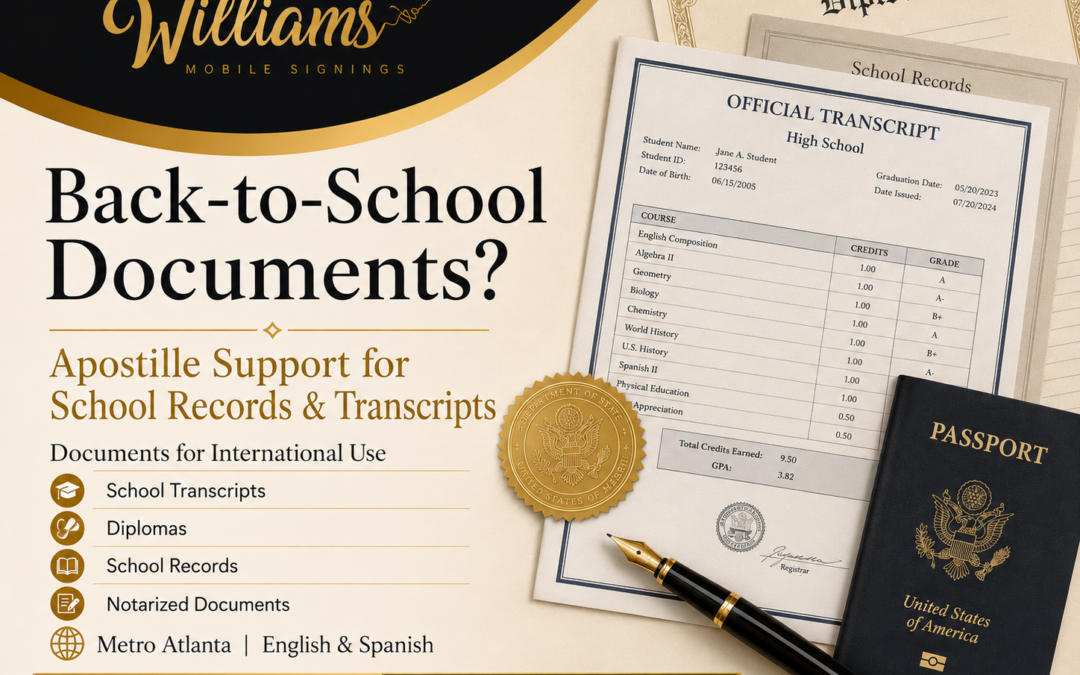
Apostille for School Transcripts: What Should You Consider?
A school transcript may be one of the first documents requested for international enrollment, university admission, study abroad, or academic credit transfer.
However, making an ordinary photocopy of a transcript may not be enough.
A school transcript may need special preparation before it can move forward in the apostille process. Depending on the document and its requirements, a school official may need to participate in the preparation process, or another step may be required.
Before submitting a school transcript for apostille processing, ask these questions:
Where was the transcript issued?
A document issued by a Georgia school may follow a different process from a transcript issued in another state.
Who issued or signed the document?
The identity and authority of the person signing or issuing the record can matter.
Do you have the correct version?
An original, a certified copy, and an ordinary photocopy are not always treated the same way.
Does the document need additional preparation?
Some academic records may require another step before they are ready for authentication.
These questions can help prevent you from starting the process with the wrong version of a document.
For Georgia families preparing school documents for international use, reviewing these details early can save time later.
What About Apostilles for Diplomas?
Diplomas may also require special preparation before they can be used internationally.
Depending on the document and destination requirements, the process may involve the original diploma, a properly prepared copy, or another form of certification.
The important point is simple:
Do not assume that an ordinary photocopy of a diploma is automatically ready for apostille processing.
Before submitting a diploma, confirm what the receiving institution requires and how the document should be prepared.
Discovering that you submitted the wrong version after an international deadline is approaching can create unnecessary delays and stress.
Other Documents Families May Need for International School Enrollment
International school-related document requests are not always limited to transcripts and diplomas.
Depending on your situation, you may also be asked to provide:
- Birth certificates
- Marriage certificates
- Custody-related records
- Parental authorization documents
- Powers of attorney
- Affidavits
- School enrollment records
- Professional credentials
- Translated documents
Each type of document may follow a different preparation process.
A birth certificate is not prepared the same way as a privately signed affidavit. A school transcript may follow a different path from a federal document.
This is why every apostille request should begin with three important details:
The document’s origin matters.
The destination country matters.
The receiving organization’s instructions matter.
Understanding those three things before beginning can make the process much clearer.
Why July Is the Right Time to Prepare Back-to-School Apostille Documents
August can arrive quickly.
By then, many families are focused on first-day schedules, travel arrangements, tuition payments, uniforms, school supplies, and last-minute registration requirements.
Starting your international document preparation in July gives you more time to determine what you actually need before the deadline becomes urgent.
July is a good time to complete the following steps.
Confirm the Receiving Institution’s Requirements
Ask exactly which documents are needed and whether they require an apostille or another form of authentication.
Gather the Correct Documents
Make sure you have the appropriate original, certified copy, or properly prepared version.
Check Where Each Document Was Issued
The location where a document originated can affect where the authentication process begins.
Identify Documents That May Need Notarization
Not every document requires the same preparation. Some documents may involve a notarization step before apostille processing.
Ask About Translation Requirements
The school, university, employer, or other receiving organization may require documents to be translated into a specific language.
Starting early is not about making the process more complicated.
It is about giving yourself enough time to ask the right questions and prepare the correct documents.
Not Sure Where to Start? Use Our Free Apostille Document Checklist
Apostille preparation can feel confusing when you are unsure which documents to gather or what information you need before beginning.
To make the process easier, Williams Mobile Signings created a Free Apostille Document Checklist to help you organize your next steps.
The checklist can help you think through important details, including:
- The type of document you have
- Where the document was issued
- The country where it will be used
- Whether you have the correct version of the document
- What questions should you confirm before beginning
Start with the Free Apostille Document Checklist
Starting with the right information can help you stay organized and reduce unnecessary frustration, especially when working against a school enrollment, study-abroad, relocation, or employment deadline.
Bilingual Apostille Support for Metro Atlanta Families
International paperwork can feel overwhelming, especially when you are coordinating requirements between two countries or communicating in more than one language.
Williams Mobile Signings provides bilingual English and Spanish apostille support in Metro Atlanta for clients who need assistance understanding the document preparation process.
We help clients review their document needs, understand the preparation steps, and coordinate eligible notarizations when needed.
Our goal is simple: to make the process easier to understand and more organized.
Whether you are preparing for international school enrollment, studying abroad, moving overseas with your family, or accepting an educational opportunity in another country, the best time to review your documents is before the deadline gets close.
Start Your International School Year Prepared
Back-to-school preparation is about more than notebooks, backpacks, and new schedules.
For families crossing international borders, preparation may also mean making sure important school and personal documents are properly prepared for use in another country.
Before August becomes busy:
Confirm what the receiving organization requires.
Gather the correct documents.
Understand where each document was issued.
Ask questions before submitting anything.
A little preparation in July can help make your transition into a new school year much smoother.
Not sure where to begin? Start with our Free Apostille Document Checklist.
Already know which documents you need help with?
Contact Williams Mobile Signings for bilingual English and Spanish apostille support in Metro Atlanta.

Valerie Williams | Bilingual Notary | Your Signature, My Seal!™ — Founder of Williams Mobile Signings