





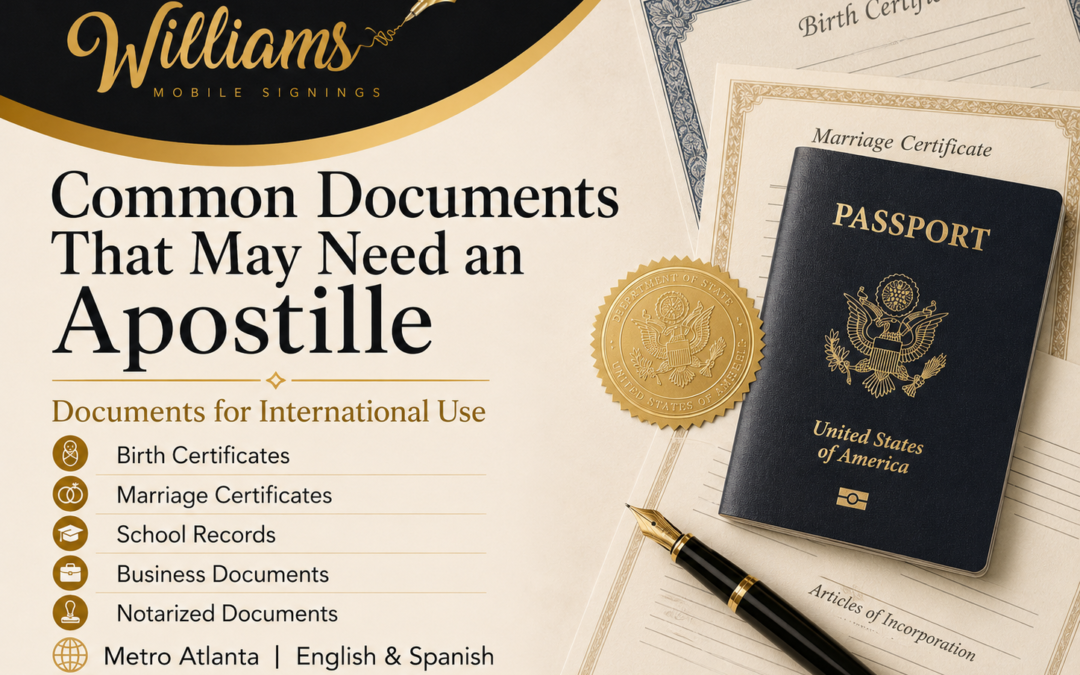
A parent calls because their child’s school transcript has to be used overseas. A student needs a diploma accepted by an international university. Another client is relocating abroad and needs a birth certificate recognized in another country.
Then comes the question every notary eventually hears, usually with no warning:
“Can you notarize this for an apostille?”
If you’ve been commissioned a while, you already know what you can’t notarize — that was the readiness check from last month. This is the version of that question that actually shows up in your inbox, and nothing in the commissioning process prepares you for it.
Here’s the short answer: notarization and apostille certification are related, but they are not the same service. Depending on the document, notarization may be one step in the process. But you, the notary, do not issue the apostille — and knowing that distinction cold is what keeps you from either overpromising a client or turning away business you could actually help with.
What an Apostille Actually Is
An apostille is a certificate used to authenticate certain public documents for use in a foreign country that participates in the Hague Apostille Convention.
In plain terms, it tells the receiving country that the signature, seal, or public official connected to the document is legitimate. It does not confirm that anything written inside the document is true — it authenticates the signature and seal, not the content.
The destination country is what decides the path: Hague Convention countries generally use the apostille process; countries outside the convention need a different authentication route. That’s why the first question you should always ask a client is:
Where will this document be used?
Who Actually Issues Apostilles in Georgia
For documents originating in Georgia, the apostille comes from the Georgia Superior Court Clerks’ Cooperative Authority — the GSCCCA. It’s the only Georgia state agency authorized to issue apostilles for Georgia-originated documents. Its office is in Atlanta, and it does not provide notary services.
So the division of labor looks like this:
- You complete the notarial act if the document requires one.
- The GSCCCA authenticates the qualifying Georgia document for use in a Hague Convention country.
A properly notarized document is not automatically apostilled — it still has to go to the GSCCCA. (Source: GSCCCA — General Apostille Information) And for documents headed to a non-Hague country, it’s the Georgia Secretary of State’s office that provides Great Seal authentication instead — a third office, doing a third job. (Source: Georgia Secretary of State — Great Seal Authentication)
Because the correct authority depends on both the destination country and the document type, tell your client to confirm requirements with the receiving school, employer, embassy, or consulate before you assume which process applies.
Does Every Document Need to Be Notarized First?
No — and this is the detail that trips up new notaries the most.
Some privately prepared documents typically need notarization before an apostille: affidavits, powers of attorney, translations, business documents, diplomas, school records.
But publicly recorded Georgia documents — birth certificates, death certificates, marriage certificates, divorce decrees, court records, certain corporate records — usually need to be official certified copies instead, and are not notarized. The GSCCCA is explicit that these must be certified copies, not notarized photocopies.
That last part matters for you specifically: a notary stamp on an ordinary photocopy doesn’t make that copy eligible for an apostille. If a client hands you a plain copy of a birth certificate and asks you to notarize it “for the apostille,” that’s your cue to redirect them to the issuing agency for a certified copy, not to notarize what’s in front of you.
Why This Comes Up So Much in August
Back-to-school season brings a predictable spike in this exact request, tied to:
- Study-abroad programs
- International school enrollment
- Foreign credential evaluations
- Overseas employment
- Family relocation
- Visa or residency applications
Diplomas and transcripts often need special handling — a school may need to prepare the document, attach a statement, or have an official sign it in front of you. An ordinary photocopy the student or parent brings in usually won’t meet the requirement.
This is exactly why it’s worth flagging to clients early: waiting until an enrollment or visa deadline is close leaves no room to fix a document that was prepared incorrectly or sent to the wrong office.
The Five Questions to Walk a Client Through
Before you ever pick up your stamp, get these answers first:
- Where will the document be used?
The destination country decides whether it requires an apostille or another form of authentication.
- What type of document is it?
A diploma, transcript, birth certificate, affidavit, or federal document may each follow a different process.
- Who issued it?
Georgia-issued documents follow a different route than documents from another state or the federal government.
- Is it an original, certified copy, or ordinary photocopy?
The format can determine whether it even qualifies.
- Has the receiving organization given instructions?
Schools, employers, embassies, and agencies often have their own requirements — get those before the document is touched.
Asking these five questions up front is the difference between a client who trusts you with their next document and a client who blames you when the GSCCCA rejects it.
How I Actually Say This to a Client
When someone asks me to “notarize it for the apostille,” here’s roughly what I tell them:
“I can notarize this for you today — that’s one part of the process. The apostille itself gets issued separately, by the state, once your notarized document is submitted to them. Let’s make sure we know exactly where this is headed and what format they need, so it doesn’t bounce back.”
That one sentence does three things: it tells the client you’re helping, it’s honest about where your role ends, and it positions you as the person managing the process — not just the stamp.
The Takeaway
A notary’s stamp is one step. It is not every step. Knowing where your job stops — and being able to say so clearly — is what turns “that’s not something I do” from a dead end into the sentence that builds trust.
I get asked this every August. Now you’ve got the exact breakdown, and a line you can use the next time a client asks.
Want the full walkthrough for what to prepare before your next appointment? Grab the free Notary Appointment Prep Checklist — it’s built for exactly this kind of scope-of-practice moment.

Valerie Williams | Bilingual Notary | Your Signature, My Seal!™ — Founder of Williams Mobile Signings